 United Kingdom
 Australia
 Canada
 France
 Germany
 Hungary
 Ireland
 Israel
 Italy
Italy Spain
Spain Mexico
 Singapore
 United Arab Emirates

The Ultimate Guide to Magnetic Paint

Introduction
Magnetic paint turns an ordinary wall into a functional, magnet-ready surface without a single nail, screw, or drilled hole. This ultimate guide to magnetic paint explains what the product is, how the technology works, the five magnetic surface types available, and how to choose, apply, and maintain the right one.
Whether you are planning a home office wall, a classroom, or a full collaborative workspace, this complete magnetic paint guide gives you the specifications and practical steps to get a strong, durable result.

What Is Magnetic Paint?
Magnetic paint is a water-based coating containing finely milled iron particles (magnetite) that create a magnetically receptive surface once applied and cured. It is not a magnet itself. Instead, it gives magnets something ferrous to grip, so notes, photos, printouts, and planning cards hold to the wall using strong magnets rather than tape or pins.
Applied in multiple coats and topped with a color of your choice, the magnetic layer stays completely hidden. The finished wall looks like any painted surface but behaves like a giant, seamless magnet board.
Smarter Surfaces Magnetic Paint contains 55% magnetite and is designed to hold roughly four sheets of paper per magnet, making it the versatile everyday option in the range. It is available in 32 sq ft and 96 sq ft kit sizes and, like every product in the magnetic range, does not interfere with WiFi or electronic signals.
H2- Why Businesses and Homes Are Switching to Magnetic Walls?
Businesses and homes are switching to magnetic walls because they offer unlimited, reconfigurable display space in a single low-maintenance surface, with no fixed board size and no wall damage. A magnetic wall scales to the exact area you need and adapts as your work changes.
The shift is closely tied to how people now work and learn. According to Owl Labs, hybrid work has settled into a lasting model, and employees consistently rate in-person days most valuable for brainstorming and collaboration.
A magnetic wall supports exactly that kind of visual, hands-on planning. For homes, the same surface keeps a family calendar, children's artwork, or a home office planning board in constant view without cluttering the space with physical boards.
| Book a free video call for tailored advice on the right magnetic surface for your project. |
How Magnetic Technology Work in Wall Coatings?
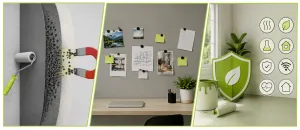
With 83% of workers now favoring hybrid setups that balance flexibility with in-person collaboration, flexible magnetic walls have become a practical fixture in modern homes and offices.
Magnetic wall coatings work by embedding a high concentration of iron particles into a paint or plaster base. When several coats are layered, the iron content builds into a continuous ferrous film across the wall, and any magnet placed against it is drawn to that iron. The more magnetite in the formula and the more coats applied, the stronger the hold.
What Makes Magnetic Paint Attract Magnets?
Magnetic paint attracts magnets because it contains magnetite, a naturally magnetic iron oxide, suspended evenly through the coating. Each coat deposits a thin layer of these particles, and stacking coats increases the density of iron across the surface, which is what a magnet actually grips.
This is why coat count matters so much, and why "does magnetic paint really work" is really a question about application. A single coat is too thin to hold reliably.
Smarter Surfaces recommends three or more coats of Magnetic Paint, four coats of Super Magnetic Paint, and a two-coat application of the thicker Magnetic Plaster. Magnetic strength scales directly with magnetite content, which is why the range steps up from 55% in Magnetic Paint, to 60% plus in Super Magnetic Paint, to 75% in Magnetic Plaster.
Magnetic Paint vs Traditional Magnets and Boards
Compared with traditional magnetic boards, a magnetic paint wall offers far more surface area, no fixed frame, and a seamless finish that blends into the room.
This is the key honest trade-off in any comparison between magnetic paint and whiteboard paint, or between magnetic paint and corkboard.
A painted magnetic surface holds less per magnet than solid steel and needs strong magnets, but it covers whole walls, cannot tear or pin-mark like corkboard, and can be topped with a writable finish. While corkboard can damage over time and a physical board can cap your space, a magnetic wall offers a durable, reconfigurable display area at any scale.
For maximum hold, pair the surface with neodymium (rare earth) Neo Magnets rather than lightweight souvenir or fridge magnets.
Safety, Durability, and Environmental Considerations
Smarter Surfaces magnetic products are formulated to be low-odor, low-VOC, solvent-free, and isocyanate-free, so they can be applied with people in the room and are safe for everyday indoor use. This matters in classrooms, kids' rooms, and offices where air quality is a priority.
On durability, the surface is built to last. Smarter Surfaces backs its Magnetic Paint and Magnetic Plaster with a 10-year guarantee, supported by independent certifications. The magnetic whiteboard products carry additional independent certifications for Fire, LEED, M1, VOC and Indoor Air Comfort, and none of the magnetic products interfere with WiFi, electronic signals, or pacemakers.
Magnetic coatings are intended for interior use. They should not be used outdoors or in consistently humid areas such as bathrooms, where exposed iron content could be affected by moisture over time. Applied to a smooth, primed interior wall and cured correctly, a magnetic surface holds its performance for years.
The 5 Types of Magnetic Paints and Surfaces
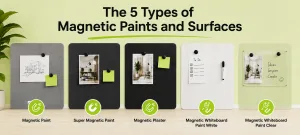
Smarter Surfaces offers five distinct magnetic surfaces, each suited to a different level of hold and function: Magnetic Paint, Super Magnetic Paint, Magnetic Plaster, Magnetic Whiteboard Paint White, and Magnetic Whiteboard Paint Clear.
Choosing correctly is mostly a question of how much weight you need to hold and whether you also want to write on the wall. The overview below explains what makes each the best magnetic paint for a given job in the USA market.
Magnetic Paint: The Versatile Everyday Option
Magnetic Paint is the standard, everyday choice, giving a reliable magnetic hold for lightweight items on any smooth interior wall. It is the most cost-effective entry point into a magnetic surface and the right pick for typical home and office display needs.
Magnetic Paint is a black, water-based coating with 55% magnetite. Applied in three or more coats and topped with your chosen color, it creates a hidden magnetic layer that holds around four sheets of paper per magnet. It is available in 32 sq ft and 96 sq ft tin sizes. Each kit includes a Neo (rare earth) magnet, roller handle and sleeve, and a step-by-step application guide.
Best Use Cases (Home, Office, Education, Hospitality)
Standard Magnetic Paint suits home offices, family organization walls, classroom display areas, meeting rooms, and hospitality settings such as hotel planning or event boards. It is ideal wherever you want to pin up notes, photos, schedules, or children's artwork without holes in the wall.
Pros and Cons of Standard Magnetic Paint
The main advantages in any list of magnetic paint pros and cons are affordability, easy water-based application, unlimited surface size, and a completely hidden finish under your topcoat. The limitations are that it holds lighter loads than the stronger products in the range, it requires strong neodymium magnets rather than weak fridge magnets, and it needs at least three coats to perform well. For heavier items, Super Magnetic Paint or Magnetic Plaster is better suited.
Super Magnetic Paint: When You Need Extra Strength
Super Magnetic Paint is the stronger paint option, formulated with a higher magnetite content for a firmer grip on heavier or multi-sheet displays. It is the right choice when standard paint is not quite enough but you still want a paint (rather than plaster) application.
What Makes Super Magnetic Paint "Super"?
This paint contains 60% plus magnetite, compared with 55% in standard Magnetic Paint, making it the strongest paint in the range. With four coats applied, it holds up to five A4 sheets per small magnet. It has a matte black finish and covers around 65 sq ft per kit. It is fire resistant, independently certified for commercial interiors, and gives a ready-to-use magnetic wall in around 24 hours.
Ideal Scenarios for Stronger Magnetic Performance
Choose Super Magnetic Paint for busy war rooms, agile and project walls, architectural studios holding full-size drawings, and any workspace where several documents hang from a single magnet. It performs well under a whiteboard topcoat to create a stronger writable magnetic wall.
Product Features, Coverage, and Technical Specs
Key specifications include 60% plus magnetite content, a four-coat application, coverage of roughly 65 sq ft per kit, and a low-VOC, solvent-free, isocyanate-free formula that exceeds US environmental standards. Like the rest of the range, it should be topped with a primer and your chosen color, or with a whiteboard finish for dual function. The kit supplies two Neo magnets, a roller handle and two sleeves, and an application guide.
Magnetic Plaster: Seamless, High-Performance Walls
Magnetic Plaster is the strongest magnetic surface Smarter Surfaces makes, delivering the highest hold for heavy or high-traffic display walls. It is a pre-mixed plaster rather than a paint, applied in a two-coat process to create a robust ferrous layer.
How It Differs from Paint?
Magnetic Plaster contains 75% magnetite, the highest in the range, and holds eight or more A4 pages with a single magnet. Unlike paint, it is applied like a plaster skim in two coats, building a thicker, denser magnetic base than any of the paint products can achieve.
When to Choose Plaster Over Paint
Choose plaster over paint when you need maximum holding power, when the wall will carry heavier materials such as thick folders or laminated boards, or in high-traffic commercial interiors where performance and durability are critical. If lightweight notes and photos are all you need, standard Magnetic Paint is more cost-effective.
Installation Requirements, Performance, and Professional Tips
Magnetic Plaster comes pre-mixed and is applied much like standard plaster, then left to cure before topcoating with paint, wallpaper, fabric, or a dry erase finish. Prime the wall first, apply two coats, and allow a minimum of 12 hours (up to 24 hours) drying before overcoating. Because it is a plaster application, some users prefer a professional plasterer for large commercial walls to guarantee a flawless finish.
Magnetic Whiteboard Paint White: Write-On, Wipe-Off & Magnet-Friendly
Smarter Surfaces Magnetic Whiteboard Paint White combines a magnetic base with a white dry erase topcoat, creating a wall you can both write on and stick magnets to. It delivers the classic bright whiteboard look with magnetic function built in.
Combining Magnetic and Whiteboard Functions
Magnetic Whiteboard Paint White is a bundle: magnetic paint coats first, then White Primer, then the white whiteboard paint topcoat. The result is a magnetic writable wall that holds around four pages and works with standard whiteboard markers. It uses a no-ghosting, stain-resistant formula and is ready to use four days after application.
Design Ideas for Offices, Classrooms, and Home Study Areas
Use it for meeting room walls that double as brainstorming boards, classroom teaching walls, and home study areas where a child can work through problems and pin up reference sheets at the same time. Because you set the dimensions, a whole wall becomes one continuous write-and-stick surface.
Cleaning, Care, and Longevity of White Whiteboard Surfaces
Clean the surface with whiteboard-safe cleaning products rather than alcohol, which can degrade the coating over time. The paint is independently certified for Fire, LEED, M1, VOC and Indoor Air Comfort and is approved for use in commercial and educational buildings, supporting a long service life.
| Not sure which surface is right for your space? Compare all five options in the magnetic products buying guide and order the magnetic paint that matches your project. |
Magnetic Whiteboard Paint Clear: Invisible Function, Visible Style
Magnetic Whiteboard Paint Clear adds magnetic and writable function while keeping your chosen wall color or design fully visible. It is the design-led option for spaces where a stark white board would clash with the interior.
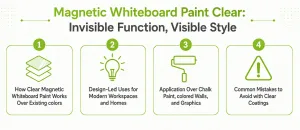
How Clear Magnetic Whiteboard Paint Works Over Existing colors
Smarter Surfaces Magnetic Whiteboard Paint Clear applies the magnetic paint in three coats first, then your chosen color, then a single transparent whiteboard topcoat. This gives you a magnetic dry erase wall in any color you like. It is tested to endure temperatures as low as minus 16 degrees Celsius, is UV resistant, and is ready to use four days after application.
Design-Led Uses for Modern Workspaces and Homes
The clear finish suits branded office spaces, designer interiors, and homes where aesthetics lead. You keep a feature color, a graphic, or a subtle neutral wall while still writing on it and sticking magnets to it, ideal for reception areas, studios, and living spaces.
Application Over Chalk Paint, colored Walls, and Graphics
Since the paint is transparent, the clear coating can go over colored walls, decorative finishes, and smooth graphics once the surface is sealed and smooth. On porous or absorbent surfaces, seal first with Clear Primer (or a suitable primer) so the clear finish does not soak in unevenly.
Common Mistakes to Avoid with Clear Coatings
The most common mistake is applying clear whiteboard paint over brilliant white or very light walls, where light interaction can cause a slight yellowing effect. For those shades, the white whiteboard product gives a cleaner result. Other mistakes to avoid are coating only part of a wall (edges can catch the light differently) and skipping the primer on absorbent surfaces.
What Can You Use Magnetic Paint For?

Magnetic paint can be used anywhere you want a flexible, damage-free display or planning surface, across homes, offices, and schools. Because you decide the size and topcoat, a single product adapts to many rooms and tasks. Common applications include:
Home offices
A magnetic paint home office wall keeps plans, deadlines, and reference notes visible above the desk, replacing scattered sticky notes with one organized, reconfigurable board.
Classrooms
Teachers create large teaching and display walls for worksheets, project work, and student contributions.
Meeting rooms
Teams hold documents, agendas, and planning cards during in-person collaboration sessions.
Creative spaces
Studios and design rooms build mood boards and iterate layouts without pinning into the wall.
Retail environments
Shops and showrooms rotate posters, price cards, and promotional material quickly.
Displays and presentations
Any wall becomes a temporary display board for events or reviews.
Planning and project management
Agile and workflow walls hold cards and charts that move as work progresses.
Children's rooms and play spaces
A magnetic paint kids' room wall holds artwork, magnetic letters, and games at low height, and because the formula is low-VOC and isocyanate-free, it is safe for these spaces.
Magnetic Wall Ideas for Homes, Offices and Schools
Magnetic walls can be designed around a specific job, from planning and teaching to display and pure creativity. Matching the wall's purpose to the right product and layout is what makes it genuinely useful rather than decorative. Popular formats include:
Magnetic planning walls
Full-wall calendars, sprint boards, and scheduling surfaces that keep timelines in shared view.
Learning and teaching walls
Classroom surfaces that mix writing (with a whiteboard topcoat) and magnet-held resources.
Project and workflow walls
Kanban-style boards where task cards move through stages, ideal with Super Magnetic Paint for multi-card magnets.
Gallery and display walls
Home or office feature walls for rotating photos, prints, and artwork with no frame holes.
Creative walls
Studio spaces for mood boards, sketches, and idea capture.
Collaborative workspace walls
Large team surfaces built for the in-person brainstorming that hybrid workers value most on office days.
How to Choose the Right Magnetic Surface?

Choose your magnetic surface by matching magnetic strength and function to what the wall needs to do, then factoring in finish, wall condition, and budget. Working through the points below will point you to one clear product.
Magnetic strength
Lighter notes and photos suit Magnetic Paint (55%); multi-sheet or heavier loads need Super Magnetic Paint (60% plus) or Magnetic Plaster (75%).
Writable functionality
If you want to write on the wall as well, choose a magnetic whiteboard paint rather than a plain magnetic base.
White vs transparent finish
Pick white whiteboard paint for a bright board look, or clear to preserve your wall color or design.
Permanent vs decorative installation
Plaster gives a permanent, high-performance base; paints suit standard decorative walls.
Wall condition
The substrate must be smooth and sound; fill, sand, and prime before application.
Intended use
Home office, classroom, retail, or high-traffic commercial each imply a different strength.
Type and weight of materials
Heavier items demand higher magnetite content and stronger neodymium magnets.
Budget
Magnetic paint is a cost-effective way to create display space at any size. Generic magnetic primers are stocked at large US retailers such as Home Depot and Lowe's, but hold quality varies with magnetite content, so compare the specification, not just the label.
Desired appearance
Decide whether the magnetic function should be visible (whiteboard) or invisible (clear or color topcoat).
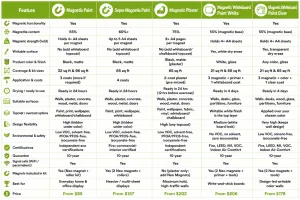
Comparison Table Between Different Magnetic Paints
The table below compares the five magnetic surfaces at a glance, so you can match magnetic strength, writability, and finish to your project. It is often the fastest way to settle which product you actually need.
fic walls; and the white and clear whiteboard options add dry erase writing on top of the magnetic base.
How to Get the Best Magnetic Performance

The best magnetic performance comes from a smooth surface, enough coats, full curing, and strong magnets matched to the load. Getting these right is the difference between a wall that barely holds a note and one that carries a stack of paper. This is also the core of how to make a magnetic wall with paint that actually works.
Before you start, gather the tools needed for magnetic paint: a short-nap or foam roller, a brush for edges, a stir stick, fine sandpaper, primer, and strong neodymium magnets for testing. Then follow these steps:
Image Alt: Six ways listed to get the best magnetic performance on your surface.
Prepare the wall correctly
Clean, fill, and sand the surface until smooth, then prime, especially on porous or absorbent substrates.
Apply sufficient magnetic product.
This answers how many coats of magnetic paint you need: three or more for Magnetic Paint, four for Super Magnetic Paint, and a two-coat application for Magnetic Plaster. Stir thoroughly and often, as the heavy iron particles settle. On how much magnetic paint you need for coverage, follow each kit's stated square footage and buy for the full wall so you do not run short mid-project.
Allow proper curing time
Let each coat dry before the next, and allow full curing before topcoating or hanging anything. Standard magnetic paint needs proper curing time between coats and is ready to use after 24 hours of the final coat. Super Magnetic Paint is ready in around 24 hours, Magnetic Plaster needs 12 to 24 hours before overcoating, and the whiteboard finishes need four days before use.
Choose suitable magnets
Use neodymium (rare earth) Neo Magnets. Standard fridge and souvenir magnets are too weak for painted surfaces.
Avoid excessive layers over the magnetic surface
Thick topcoats, heavy wallpaper, or multiple color coats add distance between magnet and iron and reduce hold. Keep topcoats thin.
Match the product to the intended load
Heavier displays need higher magnetite content, so step up to Super Magnetic Paint or Magnetic Plaster rather than over-coating a weaker base.
To confirm the result, here is how to test if magnetic paint is working: once fully cured, press a strong neodymium magnet flat against the wall and hang a single sheet, then add sheets one at a time to find the hold limit. If it grips as expected, the surface is ready to topcoat and use.
How to Clean and Maintain a Magnetic Wall?
Maintaining a magnetic wall is straightforward: keep the surface clean, use the right products on whiteboard finishes, and avoid anything that pulls the topcoat away from the magnetic layer. A little routine care keeps both the look and the hold in good shape.
Cleaning magnetic paint
A plain painted magnetic wall is cleaned like any painted surface, with a soft, slightly damp cloth. Clean tools and spills with water, as the products are water-based.
Cleaning magnetic whiteboard surfaces
Use cleaning fluids designed for whiteboard finishes. Avoid regular alcohol-based cleaners, which can deteriorate the writable surface and shorten its life.
Removing marks and residue
Wipe ink and residue promptly with a proper whiteboard cleaner and a soft cloth, then buff dry. Prompt cleaning prevents build-up that becomes harder to remove.
Maintaining the finish
Keep the surface smooth and undamaged, and avoid abrasive pads that can scratch a whiteboard topcoat.
Common mistakes to avoid
Do not use alcohol on whiteboard finishes, do not overload magnets beyond the surface's rated hold, and do not add thick extra topcoats that weaken magnetic pull.
On the common question of whether magnetic paint loses its strength over time, a correctly applied and cured magnetic surface does not lose magnetic strength through normal indoor use, which is why Smarter Surfaces backs Magnetic Paint and Magnetic Plaster with a 10-year guarantee.
| Ready to build your magnetic wall? Explore the full Smarter Surfaces Magnetic Range and create a magnet-ready surface in any size, in a matter of days. |
Common Magnetic Paint Problems and How to Fix Them
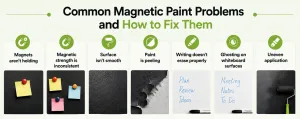
Most magnetic paint problems come down to application or magnet choice, and nearly all are fixable. If your magnetic paint is not working as expected, the causes below cover the vast majority of cases.
Magnets aren't holding
Usually too few coats or weak magnets. Add coats to build iron content and switch to neodymium magnets.
Magnetic strength is inconsistent
Often caused by unstirred paint letting iron particles settle. Stir thoroughly and often, and apply even coats.
Surface isn't smooth
Caused by a poorly prepared wall or a long-nap roller. Sand lightly between coats and use a short-nap or foam roller.
Paint is peeling
This happens mostly due to moisture or a dusty, unprimed substrate. Ensure the wall is clean, dry, and primed before painting, and keep the surface out of humid areas.
Writing doesn't erase properly
On whiteboard finishes, this points to an incomplete cure or the wrong cleaner. Allow the full four-day cure and use whiteboard-safe products.
Ghosting on whiteboard surfaces
Reduced by using the no-ghosting whiteboard formula, erasing promptly, and cleaning regularly.
Uneven application
Caused by thick or rushed coats. Apply thin, even layers and respect the drying time between each.
Is Magnetic Paint Right for Your Wall?

Magnetic paint is right for almost any smooth interior wall where you want damage-free, reconfigurable display or planning space, and the ideal product depends on strength and function. Use this quick magnetic paint guide:
- Need a magnetic wall for everyday notes and photos? Choose Magnetic Paint.
- Need stronger magnetic holding for heavier or multi-sheet displays? Choose Super Magnetic Paint.
- Want the strongest, seamless plaster finish? Choose Magnetic Plaster.
- Want a white writable and magnetic wall? Choose Magnetic Whiteboard Paint White.
- Want a transparent writable and magnetic wall that keeps your color? Choose Magnetic Whiteboard Paint Clear.
Conclusion
Magnetic paint transforms ordinary interior walls into flexible, damage-free surfaces for planning, display, and collaboration, and the right result comes down to matching magnetite strength and function to the job.
This magnetic paint guide has covered how the technology works, the five magnetic surfaces, real hold figures, application, cost factors, maintenance, and troubleshooting.
Standard Magnetic Paint covers everyday needs, Super Magnetic Paint and Magnetic Plaster handle heavier loads, and the white and clear whiteboard options add writable function.
| To find the surface that fits your space, talk to our experts and explore the full magnetic range and build a magnetic surface that works exactly the way you need. |
