 United Kingdom
 Australia
 Canada
 France
 Germany
 Hungary
 Ireland
 Israel
 Italy
 Spain
 Mexico
 Singapore
 United Arab Emirates


The Complete Guide to Projection Paint- Draft

Table of Content
Projectors remain one of the most effective ways to deliver presentations, training sessions, digital signage, and collaborative meetings. Yet many organizations still rely on bulky projector screens that occupy valuable wall space, require regular maintenance, and often limit room design.
Projection paint offers a smarter alternative. Instead of mounting a traditional screen, it transforms a smooth wall into a high-performance projection surface that delivers sharp images while blending seamlessly into the surrounding space. The result is a clean, professional installation suitable for offices, classrooms, boardrooms, museums, visitor centers, retail environments, and entertainment venues.
Modern projection paints are engineered for different lighting conditions, projector types, and applications. Whether creating a standard meeting room display, a high-contrast presentation wall, or an interactive teaching surface, choosing the right product significantly impacts image quality and long-term performance.
This complete projection paint guide explains how projection paint works, the different products available, where each performs best, and how businesses can choose the right solution for their environment.

What Is Projection Paint?
Projection paint is a specialist coating designed to transform ordinary walls into high-quality projection surfaces. Unlike standard interior paint, it has been formulated with carefully engineered reflective properties that help distribute projected light evenly across the viewing area.
Rather than installing a separate projector screen, businesses can use projection paint to create a permanent projection surface directly on the wall. Once applied correctly, the wall functions as the display itself while maintaining a clean architectural appearance when not in use.
Different projection paints have been developed for different environments. Some are optimized for conference rooms with controlled lighting, while others improve image visibility in brighter spaces or support interactive projection systems used in education and training.
The quality of the projection surface plays an important role in the final viewing experience. A properly prepared wall coated with specialist projection paint helps deliver:

- Better color accuracy
- Improved image uniformity
- Higher perceived contrast
- Reduced visible wall texture
- Professional presentation quality
Unlike ordinary white paint, projection paint has been specifically engineered to support modern projection technologies, including Full HD, 4K, laser projectors, and interactive projection systems.
Explore projection paint solutions designed for offices, education, and commercial environments.
Why Businesses Are Switching to Projection Paint
Organizations are increasingly replacing traditional projector screens with projection paint because it offers greater flexibility and creates cleaner, more modern work environments. For architects and office designers, it also provides greater freedom to integrate projection technology into the overall interior design without relying on visible screens, frames, or bulky fixtures.
Unlike conventional projector screens that remain permanently visible, projection paint allows the display surface to become part of the wall itself. When the projector is switched off, the room maintains a professional appearance without large retractable screens or fixed frames dominating the space.
For many organizations, this flexibility supports both interior design and practical day-to-day operations.

Create Larger Projection Surfaces
Traditional projector screens are limited to fixed sizes. Projection paint allows businesses to create custom projection areas that match the available wall space and projector specifications.
Whether installing a 100-inch meeting room display or a full presentation wall in a training center, the projection surface can be designed around the room rather than the other way around.
Improve Collaboration
Modern workplaces increasingly rely on visual communication. Presentation walls support brainstorming sessions, project planning, workshops, and hybrid meetings where participants need to share information clearly.
Projection paint creates a large display area that encourages collaboration while eliminating the physical barriers created by traditional screens.
Maximize Available Space
Conference rooms, classrooms, and boardrooms often have limited wall space. Replacing a mounted projector screen with a painted projection surface frees the room from unnecessary fixtures while maintaining the same functionality.
The result is a cleaner environment that can easily transition between presentations, meetings, and everyday workspace activities.
Greater Freedom for Architects and Office Designers
Modern offices are designed to be flexible, visually cohesive, and adaptable to different ways of working. Projection paint gives architects and office designers greater freedom to integrate presentation technology without relying on large screens, visible frames, or retractable mechanisms.
By turning a suitable wall into a projection surface, designers can create clean, uncluttered spaces while preserving the overall interior concept. This allows technology to blend naturally into offices, meeting rooms, collaboration areas, and client-facing spaces rather than becoming a permanent visual feature.
Projection paint also gives designers more flexibility when planning layouts, wall finishes, and multi-purpose spaces. A projection area can be incorporated into the room design without the limitations of standard screen sizes or additional mounting hardware.
Suitable for Multiple Industries
Projection paint is no longer limited to home theaters. It is widely used across commercial sectors including:
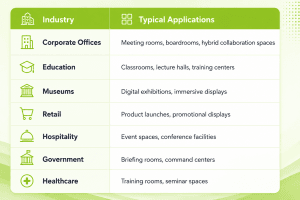
Each environment places different demands on the projection surface, making product selection an important part of achieving the best results.
Long-Term Professional Appearance
Unlike traditional screens that may wrinkle, collect dust, or require replacement over time, a professionally applied projection coating becomes part of the wall itself.
The result is a durable presentation surface that supports everyday commercial use while maintaining the clean aesthetics expected in modern workplaces.
Projection paint also eliminates concerns about retractable screen mechanisms, visible mounting hardware, or permanent fixtures that interrupt architectural design.



Types of Projection Paint
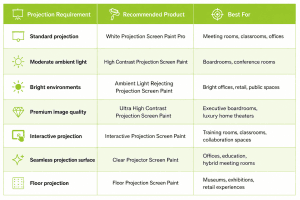
Not all projection paints are designed for the same environment. The right product depends on factors such as ambient light levels, projector type, room function, and the level of image quality required. Choosing a projection paint that matches the installation environment helps maximize brightness, contrast, color accuracy, and long-term performance.
Below are the main types of projection paint used across commercial, educational, and professional environments.
White Projection Screen Paint Pro
White Projection Screen Paint Pro is the standard solution for environments where lighting can be reasonably controlled. It creates a smooth, high-performance projection surface suitable for business presentations, training sessions, classrooms, and conference rooms.
Its high-quality reflective finish produces bright, accurate images while maintaining excellent viewing angles across the entire projection surface. For many organizations, it provides the ideal balance between image quality, installation flexibility, and cost.
Best for:
- Office meeting rooms
- Training centers
- Universities
- Conference facilities
- Standard business presentations
High Contrast Projection Screen Paint
Rooms with moderate ambient light often benefit from a higher contrast projection surface. High Contrast Projection Screen Paint improves perceived black levels and overall image depth compared with standard white projection surfaces.
This makes presentations easier to view in boardrooms and conference rooms where lighting cannot always be fully controlled.
Typical applications include executive meeting rooms, corporate presentation spaces, and customer demonstration areas where image clarity is essential throughout the working day.
Ambient Light Rejecting Projection Screen Paint
Many commercial environments cannot be completely darkened. Offices with large windows, retail environments, visitor centers, and public buildings often experience high levels of ambient light that reduce projection quality.
Ambient Light Rejecting Projection Screen Paint is designed to improve image visibility by reducing the effect of surrounding light on the projected image. This helps maintain stronger contrast and clearer visuals in challenging lighting conditions.
Organizations planning projection systems for brighter spaces should consider this solution before investing in expensive room modifications or blackout systems.
Ultra High Contrast Projection Screen Paint
Premium presentation environments demand exceptional image performance.
Ultra High Contrast Projection Screen Paint has been developed for applications where maximum contrast, color depth, and perceived image quality are priorities.
It is commonly selected for:
- Executive boardrooms
- Corporate experience centers
- High-end home theaters
- Luxury hospitality spaces
When paired with modern laser projectors and 4K content, the result is a highly immersive viewing experience with excellent shadow detail and vibrant colors.
Interactive Projection Screen Paint
Interactive projection has become increasingly popular across education, training, and collaborative workplaces.
Interactive Projection Screen Paint creates a projection surface that supports interactive projector systems, allowing users to write, annotate, manipulate digital content, and collaborate directly on the projected image.
Rather than installing expensive interactive displays, organizations can transform an entire wall into an interactive workspace suitable for:
- Classrooms
- Training rooms
- Innovation labs
- Collaborative meeting spaces
Clear Projector Screen Paint
Many organizations require a surface that creates a seamless projection surface while preserving the wall's original appearance.
Clear Projector Screen Paint combines this function into one seamless wall, allowing users to project presentations and brainstorm ideas without changing surfaces.
This solution is particularly valuable for hybrid meetings, agile workspaces, and educational environments where collaboration happens throughout the day.
Floor Projection Screen Paint
Projection is no longer limited to walls. Floor Projection Screen Paint enables immersive digital experiences across horizontal surfaces, creating engaging environments for visitors, shoppers, students, and event attendees.
Typical commercial applications include:
- Museums
- Visitor attractions
- Retail displays
- Trade shows
- Brand experiences
- Interactive exhibitions
The durable coating is designed to withstand regular foot traffic while maintaining excellent projection performance.
Check the projector screen buying guide comparison table before making your final decision.
Projection Paint vs Traditional Projector Screens
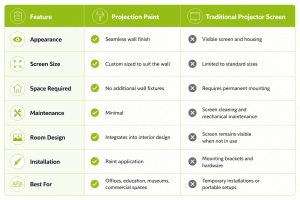
Businesses planning a new AV installation often ask whether projection paint can replace a traditional projector screen. The answer depends on the room, the projector being used, and the desired appearance of the space.
Traditional projector screens have been used for decades because they provide a dedicated projection surface that can be installed quickly. However, they also introduce visible frames, retractable housings, and fixed screen sizes that may not suit modern commercial interiors.
Projection paint takes a different approach by transforming the wall itself into the projection surface. This creates a seamless installation that blends into the room while delivering professional image quality when paired with the appropriate projector.
Greater Design Flexibility
Modern offices increasingly prioritize clean, minimalist interiors. Projection paint removes the need for visible projector screens, allowing walls to remain part of the architectural design while still functioning as professional presentation surfaces.
This approach is particularly valuable in executive boardrooms, customer briefing centers, and meeting rooms where appearance plays an important role.
Custom Screen Sizes
Unlike fixed projector screens, projection paint allows organizations to create projection surfaces that match the available wall space.
Whether the project requires a compact presentation area or an entire feature wall, the painted surface can be tailored to suit the projector and room dimensions.
Lower Visual Impact
When presentations finish, traditional projector screens remain visible. Projection paint simply looks like part of the wall, helping meeting rooms, classrooms, and public spaces maintain a cleaner appearance throughout the day.
For architects and interior designers, this flexibility supports modern commercial environments where technology should integrate naturally into the space rather than dominate it.
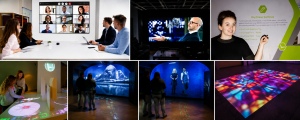
Commercial Applications
Offices and Meeting Rooms
Meeting rooms are among the most common environments for projection paint. Presentations, video conferencing, brainstorming sessions, and client meetings all benefit from a dedicated projection surface that integrates seamlessly into the room.
Clear Projector Screen Paint is particularly popular because it combines projection functionality while keeping the wall's original appearance, allowing teams to present information, take notes, and collaborate on the same wall.
Conference Rooms
Conference rooms often accommodate larger audiences and more formal presentations. High Contrast Projection Screen Paint helps improve perceived contrast and readability, particularly where lighting cannot be completely controlled.
This makes presentations clearer for everyone in the room while maintaining a professional appearance.
Classrooms and Training Rooms
Educational environments require flexible presentation surfaces that support changing teaching methods.
Projection paint allows instructors to display presentations, videos, and interactive learning materials across a large wall while making better use of available classroom space.
Interactive Projection Screen Paint extends this functionality further by allowing users to annotate and interact directly with projected content.
Museums and Visitor Attractions
Museums, galleries, and visitor centers increasingly rely on immersive digital experiences to engage audiences.
Projection paint enables large-scale wall projections, interactive exhibits, and floor projections that transform ordinary spaces into memorable visitor experiences.
Because there are no visible screen frames, exhibitions feel more integrated into the surrounding environment.
Retail and Commercial Displays
Retailers use projection paint to create eye-catching promotional displays without permanently installing large digital screens.
Projection walls can showcase product launches, seasonal campaigns, and branded experiences while maintaining a clean store layout when projections are not active.
Hospitality and Event Spaces
Hotels, conference venues, and event facilities often need flexible presentation spaces that can adapt to different clients.
Projection paint provides a permanent solution that supports corporate events, seminars, weddings, product launches, and conferences without requiring portable projection screens for every event.
Installation Overview
Achieving professional projection performance depends on proper installation. Even the highest-quality projection paint cannot compensate for poor surface preparation or incorrect application.
While each product has its own application guide, the overall installation process follows the same principles.
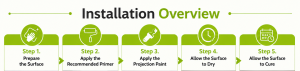
Step 1. Prepare the Surface
The wall should be clean, dry, smooth, and free from dust, grease, loose paint, and surface imperfections.
Fill any cracks or holes and sand the surface until it is completely even. A smooth substrate is essential because projector light highlights even small imperfections.
Step 2. Apply the Recommended Primer
Where specified in the product instructions, apply the appropriate primer to create a consistent base for the projection coating.
The primer helps achieve an even finish and supports the performance of the final projection surface.
Step 3. Apply the Projection Paint
Apply the projection paint using the recommended equipment and application method supplied with the product. Maintaining an even coating helps ensure consistent reflectivity across the entire projection area.
Step 4. Allow the Surface to Dry
Allow each coat to dry for approximately 2-4 hours before applying the next coat (or follow the product-specific application guide if different). Allowing sufficient drying time between coats helps achieve the smooth, even finish required for professional projection performance.
Step 5. Allow the Surface to Cure
Once the final coat has been applied, allow the projection surface to cure for at least 24 hours before using the projector. Full curing allows the coating to reach its optimum hardness, durability, and projection performance.
Choosing the Right Projection Paint for Business
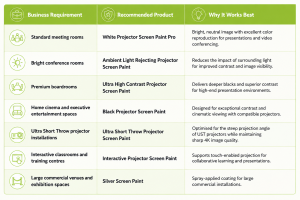
Selecting the right projection paint depends on far more than the projector itself. Room lighting, viewing distance, screen size, surface condition, and how the space will be used all influence which solution delivers the best long-term performance.
The table below compares the most common commercial applications with the most suitable Smarter Surfaces projection paint solution.
Questions to Ask Before Choosing Projection Paint
Before purchasing projection paint, consider the following:
- How much ambient light is present?Rooms with significant natural or artificial light often benefit from Ambient Light Rejecting or High Contrast projector paints.
- Which projector technology are you using?Standard, laser, Ultra Short Throw, and interactive projectors each perform best with different screen coatings.
- What screen size do you need?Unlike fixed projector screens, projection paint allows you to create virtually any screen size that fits your wall.
- Will the room serve multiple purposes?Conference rooms, classrooms, and collaboration spaces often benefit from projection paint because the wall remains clean and unobtrusive when the projector is not in use.
- How important is long-term maintenance?Commercial projection paints create durable surfaces that require minimal maintenance compared with retractable screens that include moving components.
For businesses planning larger AV upgrades, selecting the correct projection paint from the beginning helps maximize image quality while reducing future replacement and maintenance costs. Matching the coating to both the projector type and the room environment delivers the best long-term return on investment.
Cost of Commercial Projection Paint: What Businesses Should Budget For
When planning an AV upgrade, businesses should consider the total cost of the projection surface rather than simply comparing the price of individual products. Unlike traditional projector screens, projection paint creates a permanent display surface without bulky frames, retractable housings, or ongoing maintenance. This can reduce both installation complexity and long-term ownership costs.
The exact investment depends on the size of the projection area, the projector being used, and the room environment. Smaller meeting rooms may only require a single kit, while large conference spaces, training centres, or auditoriums may need larger coverage options or specialist coatings.
Budgeting for Multiple Rooms
Many businesses upgrade multiple meeting rooms, training rooms, or classrooms as part of a wider workplace modernisation project. Calculating costs on a per-room basis makes budgeting far easier than comparing individual paint kits.
For example:
- Small meeting room: approximately 80 to 100 inch projection surface
- Medium conference room: approximately 100 to 120 inch projection surface
- Large boardroom or training room: custom-sized projection wall
Because projection paint allows the screen size to be customised, organisations avoid purchasing multiple screen sizes or paying for bespoke framed screens. Larger projects may also qualify for volume pricing or commercial quotations.
Projection Paint vs Traditional Projection Screens
Although a fixed projector screen may appear less expensive initially, it often includes additional costs for mounting hardware, installation, maintenance, and eventual replacement. Projection paint transforms the wall itself into the display surface, eliminating many of these expenses while providing a clean architectural finish.
For businesses investing in modern collaboration spaces, projection paint delivers long-term value by combining professional image quality with lower maintenance requirements and greater design flexibility.
Projection Paint Maintenance and Long-Term Performance
One of the biggest advantages of projection paint in commercial environments is its low maintenance. Unlike traditional projector screens that include frames, housings, and retractable mechanisms, a painted projection surface becomes part of the wall itself. With proper application and normal care, it continues delivering consistent image quality for years while requiring very little upkeep.
Easy to Clean
Projection paint is designed to create a durable finish that withstands everyday commercial use. Dust and light surface marks can usually be removed with a soft, dry microfibre cloth. Where necessary, follow the manufacturer's cleaning recommendations to maintain the projection surface without affecting image quality.
Avoid abrasive cleaning products, scouring pads, or harsh chemicals, as these may alter the surface finish and reduce projection performance.
Built for High-Traffic Commercial Spaces
Meeting rooms, classrooms, training centres, and conference facilities often experience daily use. Projection paint eliminates many of the maintenance issues associated with traditional projector screens, including:
- Torn or damaged screen fabric
- Wrinkled projection surfaces
- Mechanical failures in retractable screens
- Dust collecting inside screen housings
- Misaligned or sagging screen frames
Because the projection surface is integrated directly into the wall, there are no moving parts to service or replace.
Long Lasting Performance
Commercial projection paints are formulated to provide reliable image quality over the long term. When applied according to the manufacturer's instructions, the coating maintains a smooth projection surface that supports consistent brightness, color accuracy, and image clarity throughout years of regular use.
Many organisations choose projection paint because it continues performing well even in heavily used collaboration spaces, helping reduce future maintenance and replacement costs.
Can Projection Paint Be Repaired?
Minor wall damage can often be repaired without replacing the entire projection surface. If repairs become necessary, follow the product-specific repair recommendations to restore a consistent finish. In some cases, applying a fresh coat over the affected area or repainting the complete projection surface may be recommended for optimum visual consistency.
Warranty and Product Support
Smarter Surfaces projection paints are developed for professional and commercial installations and are backed by comprehensive product warranties. Detailed application guides, technical documentation, and customer support help businesses achieve the best possible results from initial installation through long-term use.
Whether upgrading a single meeting room or rolling out projection surfaces across multiple locations, selecting a high-quality projection paint helps ensure dependable performance with minimal ongoing maintenance.
Final Thoughts
Projection paint has transformed the way businesses, educational institutions, and commercial organizations create presentation spaces. Rather than installing bulky projector screens that dominate the room, projection paint converts the wall itself into a professional display surface that integrates seamlessly with modern interior design.
From small meeting rooms to enterprise conference facilities, projection paint delivers flexibility, scalability, and long-term value. Businesses can create custom screen sizes, reduce maintenance requirements, and achieve excellent image quality while making better use of existing wall space.
The right solution depends on several factors, including projector type, room lighting, viewing environment, and intended use. Whether you need a bright projection surface for everyday presentations, an ambient light-rejecting solution for challenging environments, an interactive wall for collaborative learning, or a dedicated Ultra Short Throw coating, selecting the appropriate projection paint ensures the best possible performance.
Since 2009, Smarter Surfaces has helped organizations in more than 20 countries transform ordinary walls into high-performance projection surfaces. Manufactured across the UK, Europe, and Ireland to rigorous quality standards, Smarter Surfaces projection paints are trusted by businesses, universities, schools, government organizations, healthcare facilities, and AV professionals worldwide.

